


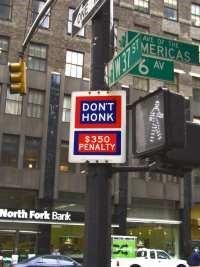
New York City is known as the city that never sleeps��and for good reason: the city noise can be enough to keep anyone awake 24/7. In a city packed with millions of people, who often live in tight quarters, New York City residents experience noise pollution from both external sources (construction, for example) as well as within residential buildings. Recent regulations have been introduced to address noise within the city. In addition, there are steps boards, shareholders and residents can take to lessen the amount of noise within co-ops and condos.
The Latest in Noise Regulations
Although New York City has had noise laws on the books for many years, recent changes to those laws reflect the current state of the city's noise-pollution challenges. According to the Mayor's Management Report, released in September 2007, "The 311 Customer Service Center received 1,163,177 NYPD-related inquiries in Fiscal 2007, which generated 383,688 quality-of-life-related service requests, of which 62 percent were noise-related."
"There wasn't any comprehensive noise code until the 1970s," says Steven R. Wagner of the law firm of Wagner Davis PC in Manhattan. "Noise control laws were a hodgepodge and the noise control code was an attempt by the city to locate the majority of the laws in one place. Updating them over time was an attempt to make them more accessible and enforceable."
"Originally the noise law was Local Law 57 of 1972, which was amended in 1985, overhauled in 1998 and then again in 2005. It became effective on July 1, 2007," says Wagner.
"The new noise code addresses the number one quality of life complaint in New York. In 2006, 350,000 noise complaints were made through the 311 system, so it really is the number one quality of life issue," says Michael Saucier a spokesperson for the New York Department of Environmental Protection (DEP).
Michael A. Newman of Dunn, McNeil, Ramsay Inc., a Manhattan-based consulting engineering firm, with an expertise in issues of sound and vibration, says the new noise code "reflects the city's current landscape and takes into account advances in acoustics technology. For example, soundproofing materials for wall assemblies, floor and ceiling assemblies, and soundproofing for windows and so on have significantly improved. Some of the materials used today were not available 10, 15 or 20 years ago."
"The noise code addresses issues including barking dogs, music from clubs and construction sites," says Saucier. "Residents deserve as much peace and quiet as they can get in the context of a lively, thriving city of 8.2 million people. And over time we will see a difference. Just by having a plan that people know is in place will help cut noise some."
The new code outlines rules and regulations for governing noise, and sections of the code are enforced by the DEP and the NYPD.
"The new code is all about finding a balance, not about turning the city into a farm town. People do have a right to sleep," says Saucier.
In addition to the noise code, noise laws are contained in other statutes.
"For example, part of the Criminal Code has a prohibition against excessive noise. The Alcoholic Beverage Control Law has provisions on excessive noise, and the Public Authorities Law also has provisions on excessive noise," says Wagner.
The Basics of Noise Measurement
Noise is always present, and whether or not something creates a disturbance is subjective. Noise can be measured in decibels (dB) by a sound meter, which records the levels of sound graphically. These numbers show changes in sound. Noise is measured against ambient sound, which is the noise that is always present, or background noise. These instruments locate and separate the sound, and determine the background noise.
The sound we hear is quantified in decibels. For example, says Newman, "If you're whispering, that's 30 decibels. Normal conversation is in the 50 decibel to 65 decibel range area." Louder noise, such as traffic outside, usually ranges from 70-85 dB. A train or subway is about 100 dB. A jackhammer is 120 dB and a jet plane taking off is measured at 130 dB or greater.
"When somebody is upstairs in a condo on an exercise machine, the decibels increase from maybe 55 to 60 to 110. Not only are you creating additional sound, you're creating vibration. The vibrations that are caused by a treadmill go into the building and into the columns in the floor, down the columns and into the floors above and below," says Newman.
Penalties and the Biggest Offenders
With construction occurring all over the city, year-round, it's no wonder that noise from construction is the number one noise-related complaint. Living with and tolerating noise from nearby construction sites is easier said than done. If noise becomes excessive, however, there are steps that can be taken to report the problem.
"If a construction site is outside your home, you'd call 311 and we would schedule an appointment and go and check it out, and from there, a few things could happen," says Saucier. "Those include issuing a notice of violation, or getting a noise mitigation plan in place by a certain date if the noise was about a certain decibel level. If there's a complaint, we will respond and a judgment is made."
The type of violation dictates whether it will be handled by the DEP or NYPD.
"Enforcement is shared between the DEP and police department. How one would address a construction site would differ from how a nightclub would be addressed or an ice cream truck would be addressed. Either way, the possibility of the source receiving a notice of violation is there," says Saucier.
"Penalties under the new code have increased," says Newman. "They are dependent upon the selection of the code violation. One might be a construction job site, another is someone banging on the floor in an apartment."
Fines can become extremely expensive: For example, a construction site that hasn't responded in 30 days can be held responsible for each of those days.
Reducing Noise Inside
Ideally, every resident of a co-op or condo would keep his or her neighbors in mind when making any kind of noise. Unfortunately, many residents at one time or another have had to deal with a loud neighbor. This is especially true when units share walls, or when the ceiling of one unit is also the floor of the unit above it
"At night, shareholders of units can do certain things to attenuate the noise in their apartments. They can pay attention to not walking heavily, talking loudly or shouting in the unit above," says Newman. They can also keep the volume low on sound reproduction devices, such as televisions and speaker systems, and limit playing musical instruments to during the day, not in the evening.
In addition, shareholders can be respectful of their neighbors by not placing exercise equipment, such as a treadmill, above the bedroom of the unit downstairs.
Placing washing machines or dryers on vibration isolators, which absorb some of the machine's activity, also reduces noise within buildings.
"The way you attenuate sound is by mass. If the sound is passing through, there may be something that can be done to increase the mass, such as using heavy carpeting on floors or something between the walls of two adjacent apartments," says Wagner. "There's the 80 percent rule, which states that 80 percent of floors must be carpeted."
It's also wise to make sure that any holes between apartments are sealed up, which will reduce sound traveling from one residence to another.
"Sound passes wherever there are holes between apartments," says Wagner. For example, sound travels through the spaces around pipes that run through multiple apartments.
Aside from noisy residents, features of the building itself could be creating a disturbance. In co-ops and condos, this could come from mechanical sources, such as mechanical equipment on the roof, air conditioners, exhaust fans or elevators. These issues can all be looked at and attenuated, says Newman.
Addressing Shareholders Concerns
While the new noise code addresses many commercial situations, says Wagner, with the exception of noise from animals, there's no standard between residential apartment to residential apartment. When noise is coming from within the building, shareholders will often bring the matter to the board. It's important that the board communicate to all shareholders that they are concerned with everyone's right to peace and quiet, and encourage residents to respect each other.
"In a co-op, the warranty of habitability applies because you have a lease, so the board is responsible as a landlord to try to abate the problem," says Wagner.
Try to settle the dispute without picking sides, and without heading right to court. If you do head to court, be prepared for a difficult battle.
"The complaints I get most often in residential situations are about music and noise made by children," says Wagner. "I try to have parties to mediate, or I try to steer the board away from commencing lawsuits unless they have solid evidence that one party is overwhelmingly creating noise to the detriment of the other party."
He notes that it is difficult to win a case involving excessive noise unless you have technical expert evidence that shows that noise is coming into an apartment way above any reasonable level.
"Unless it's really outrageous, it's unlikely you'll get a judge to evict someone from a co-op. You have to pack a courtroom to win a case like that," says Wagner. "I had a case where the court distinguished between what was disturbing and what was an inconvenience. Children running around was considered an inconvenient—but normal—activity."
So what constitutes noise? Because it is such a subjective matter, it can be difficult to prove that someone is truly disturbing others. The language in a typical proprietary lease can help define noise, as well as set forth rules and regulations.
"A typical proprietary lease might read, 'No lessee shall make any disturbing noise in the building that will interfere with the rights, comfort or convenience of the other lessees.' Then there also can be specific prohibitions about playing musical instruments or stereos," says Wagner.
If your board finds itself stuck in the middle of two residents, or with a noise problem that seems to have no easy fix, it might be time to call in an expert who can offer solutions to attenuate the noise. Consultants can conduct a site visit, interview the client, conduct a field inspection, develop field notes and make a sketch. They also take physical, sound and vibration measurements and take photographs for exhibit purposes of a unit. A consultant might also examine, read and review any correspondence, documents, plans and specifications and invoices, and analyze that collected data.
"We produce written reports containing recommendations for remediation, product specifications for mitigation, a timeline for completion of work and a dollar estimate of costs," says Newman.
If your board decides it needs a consultation, it will run approximately $1,750 to $3,500 (or $250 to $300 an hour), according to Newman.
Noise from construction sites, traffic and even your neighbors will likely continue to be an issue for New Yorkers. And while the city will never be silent, boards can take steps to address excessive noise problems and attenuate noise within their co-ops and condos. Addressing shareholder concerns—whether by calling in an expert or drafting rules to lessen noise from individual units—can go a long way in keeping residents happy. And even though noise can never be eliminated completely, there are ways to get some peace and quiet - and hopefully a good night's sleep.
Stephanie Mannino is a freelance writer and published author living in Hoboken, New Jersey






28 Comments
Leave a Comment