
Today's Trash Cycle
Apartment-dwelling New Yorkers have a tendency to spoil their trash. That is, they allow it to stink. Read More
Avoid a Headache
The New York City Department of Consumer Affairs (DCA) receives more complaints against home improvement contractors than any other category - Period. If you engage an unlicensed, unregistered contractor to carry out an improvement project in your co-op or condo, you may be courting disaster. Everything may go fine, but then again, it may not. What if, for example, your contractor simply disappears, leaving the apartment in disarray - walls torn apart, wiring and plumbing exposed, and other work undone? The damage to your own apartment or neighboring units can cost you hundreds, thousands or even hundreds of thousands of dollars. Read More
Whither Your Window?
The eyes may be the windows of the soul, but windows are the eyes of your home, looking out onto the world and letting in air and light. More than just plain old sheets of ordinary glass, today's windows are loaded with features designed to increase fuel efficiency, block noise, cut down on cleaning time, and improve your view. Read More
Gimmie a 'J'... and a '421a'
Four years ago, the co-op at 430 West 34th Street in Manhattan was in trouble. The 17-story, 168-unit vanilla brick building needed money - and needed it quickly. A couple of major capital projects, including new window installation, grouting and a boiler replacement, were looming, and the board didn't have the money to complete them. Read More
Keep History Standing
New York has been dubbed "The Greatest City on Earth"¯ for a myriad of reasons - not least of which is the Big Apple's sheer architectural impressiveness. Legendary buildings and neighborhoods like the Empire State Building and Harlem are recognized around the globe and rich in history. Since the late 1960s, New York City has made a commitment to preserve these and other less recognizable - though no less historically valuable - sites. To try to repair or alter a landmarked building requires a lot of legal wrangling and bureaucratic red tape and money, even if the building is a privately owned residential building. Read More
How Legal is That Doggy in the Window
Ever wonder how that frisky pug got the penthouse window seat in a "pet-free"¯ building? Or how that tabby from 4C manages to saunter down the hall like he owns the place? Thanks to New York City's "pet law,"¯ many co-op and condo owners have found a way to keep a pet or two despite their building's otherwise anti-pet policy. Read More
The Kids Are All Right
Your home is supposed to be a sanctuary - your family's protection from the hazards and harms of the outside world. Unfortunately, what should be a haven can often be full of hazards, especially for children, whose curiosity can be their own worst enemy. According to the National Center for Health Statistics, 42 percent of pediatric deaths happen right in the child's own home, including drowning, burning and scalding, choking, poisoning, and falling. Prevention is the key to reducing the risks of injury to any family member. Read More
Come On In!
New Yorkers are a famously busy bunch, always looking for ways to maximize their time. Buying or selling an apartment can be the most time-consuming process imaginable, and city dwellers are always eager to try out ways of moving things along: Hence the enduring popularity of open houses - one of the most efficient ways of unloading or snapping up real estate. But how do group events stack up against private showings? And what's the best way to run an open house? Are there mistakes to avoid? Read on, and the open house will be an open book. Read More
Unearthing Bloemendaal
Thanks to the city's preservation efforts, most of the buildings lining Columbus Avenue from 67th up to 82nd Streets are first-generation developments. These designated landmarks, with their original storefronts intact, elicit memories of the quaint, little old New York of more than a century ago. Yet, even in this carefully tended historic district, only a fraction of the Upper West Side's rich history is preserved. Read More
Do the Can-Can
Nearly two months into Mayor Michael Bloomberg's suspension of glass and plastic recycling - a move designed to trim $40 million from the city's budget - New Yorkers are slowly getting used to the idea of tossing their Pepsi and beer bottles out with their regular trash. Read More
Green is Gorgeous
Kermit the Frog once sang, "It's not easy being green."¯ In truth, New York-area co-ops and condominiums are discovering that "going green"¯ is easier and more cost-effective than ever before. No, you won't be seeing a rash of high rises with elaborate landscaping or emerald paint jobs. In common language, to be "green"¯ is to be ecologically and environmentally conscious. Green buildings conserve resources, minimize pollution, and in many cases save their residents money. Thanks to both private and government programs, residential buildings can develop strategies for greening their property, and then get the funds to pay for program implementation. Read More
Turning On the Lights
Once upon a time, like many cities across the nation, New York City had a government-regulated energy market. There was one number to call to make all the lights come on: Consolidated Edison of New York (or, more familiarly, Con Ed). This streamlined - if limited - way of doing things persisted until the summer of 1998, when the New York State Public Service Commission (PSC) began implementing a deregulation plan the commission had been formulating since 1996. Read More
Choosing an ESCO
Saving money is always a top concern of any co-op or condo board, so when energy deregulation first offered customers the opportunity to choose their energy provider in 1998, it seemed that lower energy bills were on the way. But in the time since deregulation first came into effect, many companies have not survived, and many customers have not realized the savings they'd hoped for. So what's the best way to choose a new energy service company (ESCO) and find a good deal, if you're still looking to switch? Read More
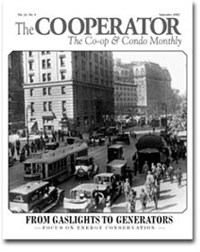
Gaslights to Generators
In 1863, when a tenant at 97 Orchard Street came home from work, he entered a pitch-dark hallway and had to feel his way up the stairs to his apartment. He most likely felt his way with one hand while carrying a bucket of coal for the stove, or a pail of water to wash with, in the other. There was no central lighting in the hallways, and his apartment was lit by candles or oil lamps. There was no running water. To use the toilet, he went out back to the six privies that the building shared with the patrons of the saloon that occupied the street level. Read More