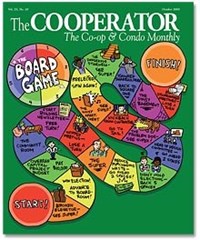

2005 Oct

2005 Oct

2005 Oct Vol. 25, No. 10

Focus on...Board Operations

Board/Building Harmony

By C. Jaye Berger, Esq.

As an attorney who represents co-op boards, building managers and shareholders, one sometimes wonders if the expression—“ You can’t please all the people all of the time” best applies to the idea of creating harmony between these parties. However, I believe that there is hope and that you can try to please more of the people more of the time, if you just listen to what they are saying and respond promptly. Read More

A Tree With Many Branches

By Mary K. Fons

They say that it takes a village to raise a child. If that’s true, then it takes even more than that to keep the thousands of New York City co-ops and condominium building communities solvent, harmonious, and informed. With all its potential social, political, and financial quagmires, who on earth would take on such a job? Enter the Council of New York Cooperatives & Condominiums (CNYC), an organization founded in 1979 by a group of people up to the challenge. Read More

Where City and Community Meet

By Anthony Stoeckert

You know you’re living in a hot neighborhood when people from Manhattan visit the area to sample the restaurants and shopping. That’s exactly the status enjoyed by Park Slope, Brooklyn, the area under the south side of Prospect Park that is home to a varied and vibrant population that includes students, young married couples, new parents, wealthy professionals—and some longtime residents who stuck with the area through some rough times and are now enjoying the social and financial fruits of the neighborhood’s revitalization. It’s hard to find someone who lives in “The Slope” who doesn’t love it. Read More

Business Corporation Law

By Bruce A. Cholst Esq.

The Business Corporation Law, or BCL, is one of the primary statutes regulating operation of cooperative housing corporations. The BCL was implemented over a century ago, and remained more or less unchanged until it was overhauled in 1998. The BCL provides a template for managing the board election process and protecting shareholders’ rights, and outlines legal methods of corporate governance. The following is a summary of some of the key points in the BCL impacting cooperative apartment corporations—things every board member and managing agent should be aware of, plus some points that should be of interest to shareholders themselves. (It should be noted, however, that these items apply to co-ops’ bylaws and Certificates of Incorporation, not their proprietary leases.) Read More

Industry Standards for Public Spaces

By Marilyn Sygrove

The lobbies and hallways of residential buildings are not high-end private residential projects—yet they’re not back stairwells or utilities spaces either. They literally fall somewhere in between, and no matter how new or sophisticated the building itself is, or how lavishly constructed, by the very nature of architecture and construction, nothing is exactly straight or perfectly plumb. It’s a given on any project that almost all walls, floors and ceilings will be out of alignment—it is just a matter of how much. As interior designers, we are not hired to re-build the building. We are hired to enhance its appearance, which increases value for residents, as well as attracting prospective buyers. Read More

The Wild West

By Raanan Geberer

After what seemed like years, the wrangling over the proposed West Side Stadium in Manhattan and the city’s bid for the 2012 Olympics is over. A new stadium will now be built in Queens, not Manhattan; New York wasn’t chosen for the Olympics in 2012; the Jets, sans Chad Pennington, are still in New Jersey; Chelsea residents like this reporter no longer get “No Stadium!” flyers under our doors, and opponents of Mayor Michael R. Bloomberg must now find new issues to fight over. Read More

To Err is Human

By Michael McDonough

Boards of directors are usually made up of ordinary people, elected or appointed by their neighbors to run their building smoothly and efficiently. Most board members do their utmost to fulfill that expectation, but occasionally, even the most well-intentioned board members can make mistakes—some of which may have serious legal ramifications for their buildings. Fortunately help is available to both novice board members as well as seasoned veterans, in the form of fellow board members, building professionals and seminars. Read More

Taking Charge

By Keith Loria

Every co-op shareholder knows that their board president is responsible for making decisions that affect the entire building community—but not as many grasp the amount of responsibility and decision-making that a person undertakes when they become board president. Read More

Better Meetings

By Anthony Stoeckert

Is there anybody in this world who likes sitting through meetings? Too often they seem pointless, endless and directionless. But they’re part of co-op and condo life, an important part in fact, so if you’re a board member or property manager, it’s best to accept them and make them as useful and worthwhile as possible. Read More

The Balancing Act

By Elizabeth Lent

With upkeep and mortgage payments, even the occasional renovation, owning your own co-op or condo can be work enough on its own. Now imagine being responsible for 10 units, or 50, even 200. That daunting task is up to each building’s board of directors and managing agent. Together, they form the team that makes sure each co-op and condo community runs smoothly and efficiently, making them a welcoming and safe place for shareholders and unit owners to live and play. Read More

On the Board

By Lisa Iannucci

All she wanted to do was to sell her co-op apartment. Although she used her ground-floor property both for work and as a residence, she wasn’t quite sure whether it could be sold as a live-work apartment. So she did what she thought she should do—she went to her board and asked. Read More

Building Operations

On The Board

NYC Living

Newspaper subscription

subscribe Subscribe to "The Cooperator" newspaper - it is FREE. Manage my subscriptions

E-Mail Newsletter

Would you prefer receiving the summary of new articles by e-mail? Your E-Mail: