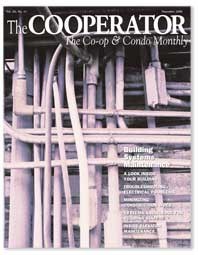

Glen Oaks Village
Like so many other neighborhoods and areas of the city, the Glen Oaks Village cooperative in Queens has seen its share of good times and not-so-good times. But from the bleak days of the 1970s and ‘80s, thanks to a conversion, a committed, self-managing board, and involved shareholders, the picture at Glen Oaks Village today is very different from what it was a couple of decades ago. Read More
Controlling for Fraud
A little over four years ago, the Sarbanes-Oxley Act (SOX) was signed into law. The most significant provision was Section 404, which requires corporations to conduct an annual assessment and report on the effectiveness of their internal financial controls. Read More
The Final Frontier
Sometime in the future, perhaps, teleporters like those seen on Star Trek will be a reality. Every co-op and condo building will have one—not for purposes of travel, but for storage. Until technology allows us to beam our bins and boxes of old clothes, holiday decorations, and unused sporting goods to a depot in, say, South Dakota, however, nobody in New York City will have enough space for storage. Read More
Going Up?
In a vertical city like New York where it’s not uncommon for people to wake up in a mid-rise apartment building before heading to work in a midtown skyscraper, it’s easy to take elevators for granted. Easy, that is, until something goes wrong with one. And when something does go wrong, it can even end up in the next day’s headlines—like in April, 2005, when deliveryman Ming Kuang Chen spent three days trapped in the elevator of a Bronx high-rise. Or like last May, when several young tourists were stuck very publicly inside the glass elevator cage at Apple’s brand new Fifth Avenue store in Manhattan. Read More
Knowing the Ropes
Helping veterans and newcomers alike to become certified accredited realty managers (ARMs), the New York Association of Realty Managers (NYARM) has been perfecting the skills of those in the field with their School of Property Management for nearly two years now. Read More
Breakfast Roundup
Managing a co-op or condo community is far from an easy job. Six managing agents from some of the city’s top firms recently participated in the continuing series of roundtable discussions hosted by The Cooperator and the Federation of New York Housing Cooperatives and Condominiums (FNYHC) to provide some insight into the intricacies of co-op and condo management. Read More
Bringing Water to the Masses
The skyline of New York City is unique, if not for the soaring glass, steel, concrete and brick skyscrapers that create caverns in the sky, but for the redwood and cedar water tanks that sit on rooftops and hearken to days gone by. Read More
Know Holes Barred
Water leaks are the bane of many an apartment owner—and many a building superintendent. The innocent drip-drip-drip sound can augur waterfall-like hardship if not properly addressed. Leaks can cause major structural damage, ruin property, and set the stage for a potentially worse problem: mold growth. Read More
Going Green
Time was, if the tiles in your building’s front foyer got grimy, your super would pour some ammonia or bleach in a bucket, grab the nearest mop, and get down to business. If a drain was slow, out came the heavy-duty industrial solvents, and down the hatch. Today however, things are different in a great many buildings. There’s been a shift away from harsh, potentially dangerous cleaners and chemicals in residential buildings, and more and more boards and managers are requiring their building staff members to shelve the strong stuff in favor of gentler, less volatile “green” products. Read More
Knowledge is Key
Residential buildings are complicated entities—their various operating systems require maintenance and occasional repairs to remain in good working order. Sometimes maintenance can be carried out by the super or handyperson—sometimes it can’t. In the latter situation, it’s necessary to call in the help of a professional. Either way, it falls to the building super or the manager to decide whether a particular problem can be dealt with in-house or needs the attention of a specialist. For this reason, building administration and management—not just the super—need to have a certain amount of knowledge about their building’s structure and systems in order to do their jobs most efficiently. Read More
Caution Ahead
For many co-op and condo owners, watching the work crews arrive and the scaffolding ascend into the sky is akin to seeing the storm clouds gather on the horizon. They can be a harbinger of dark days to come, filled with noise, dust and inconvenience. Read More
The Shocking Truth
Today, almost all residents of co-op and condo buildings are computer-knowledgeable. They can tell you how many ports your PC has, how many gigabytes are in the hard drive, how to set up a printer, and more. Read More
Q&A: Whose Cable Now?
Our building is seriously considering replacing our present cable television with a satellite dish system. Cablevision installed TV cables and equipment in our hi-rise residential condo building several years ago, and has continued to be our cable provider. We need to know who is presently the lawful owner of the TV cables and equipment in our building. Do we have to ask permission from Cablevision to remove, replace or use the existing TV cable for our own purposes? Read More
Q&A: Family Trust
My parents are both in their seventies and have begun setting their financial affairs in order. They have put whatever assets they own, such as cars, stocks and bonds, into their family trust in order to simplify their estate and avoid probate. Read More
Q&A: To Flip, or Not to Flip the Tax
Our 60-unit, self-managed co-op changed its bylaws about ten years ago to allow parents to sublet from their children and vice versa. The bylaws were changed with the condition that the flip tax would continue with any transfer of the apartment. The owners are claiming there is no change in ownership or tax status since the apartment is staying in the hands of a member of the same family. Is this legal and should we continue to require a flip tax transfer for the subtenants even if they are related? Any advice would be most appreciated. Read More
Q&A: Sole Access, Sole Responsibility!
I live in an older co-op that has eight large roof-terraces from 300 to 500 square feet. We have experienced leaks emanating from these terraces, over the years, to the apartments below. No one is able to use the terraces except the shareholder that has sole access to them. The square footage of the terrace is included in the shareholder’s monthly maintenance fee at a reduced rate since the terrace is only used for part of the year. This reduced maintenance fee was decided on years ago by the board at the time. Because of the difficulty in finding the leak, repairing it and then removing most if not all the tiles to replace them with new ones, we have found the costs to be outstanding. Read More