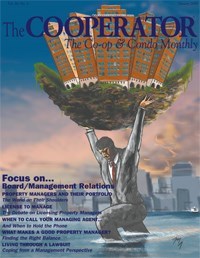

The World on their Shoulders

If your planner or BlackBerry is full of to-do lists and scheduling conflicts, if you're often running up against deadlines and your cell phone rings constantly, you've got a lot in common with a New York property manager. Read More
The Debate on Licensing Property Managers
In a number of states throughout the U.S., including Florida, Nevada and the District of Columbia, property managers are required by law to be licensed. This is not the case in New York, although a debate over the necessity of licensing has boiled quietly—and sometimes not so quietly—under the surface for decades. As can be imagined in a city of eight million property-obsessed people, there are myriad voices and opinions on the subject. Read More
When to Call Your Managing Agent...
Whenever a problem arises, board members often have a knee-jerk reaction to call their managing agent immediately. In many cases, this is appropriate. But although it might be part of their job to communicate with the board, managing agents might not be able to respond to every call right away. And if your board is calling too frequently, your persistence might begin to irk your manager and put a strain on your working relationship. Read More
What Makes a Good Property Manager?
A good property manager is like a hip dad. He or she may not say things like, "Hey pal, whatcha say we go toss around the ol' pigskin?" but like a hip dad, a property manager needs to have a certain set of specific traits and other, harder-to-define skills in order to be successful. Read More
Coping From a Management Perspective
Lawsuits are an unfortunate, often expensive fact of life these days, and co-op and condo communities are not immune from seeing the inside of a courtroom, or at least a lawyer's office suite. An issue that arises between a resident and the board or between two or more residents can spiral out of control, wind up involving the managing agent, and end up in court. Then it becomes a battle of he-said/she-said until the lawsuit is over, a settlement is declared and it's back to building business as usual. Or is it? Read More
Above and Beyond Management
It's been said before, but bears repeating: while there are certain similarities, every co-op and condo building in New York City is different, and every building community has different needs, expectations, and amenities. Those expectations and needs may change over time as well—what works for one community for a few years may not work so well as building demographics shift and redesign themselves. Read More
Are We Immune?
For almost a year now, we have been hearing more and more about the subprime mortgage crisis. Subprime mortgages are mortgages that banks sell to borrowers whose problematic credit ratings do not allow them to get mortgages at better rates. Read More
The Real Estate Board of New York
For most New Yorkers, the search for housing is the least favorite part of the New York experience. If the size is right, the price is wrong; if the price is right, the neighborhood's wrong. And then there's that hideous bathtub in the kitchen. In an area as popular and populous as metropolitan New York, finding a unit that meets all your needs is darn near impossible. The Real Estate Board of New York (REBNY) hopes to change all that. Read More
Maintaining Stone and Metal Work
New York City's condos and co-ops are more than just apartment buildings—they're part of one the most famous architectural landscapes in the world. Next time you walk around the city, slow down and notice the beautifully designed structures with stunning façades: you might see wrought-iron gates, some as old as 100 years, or decorative metal balconies. Take a look inside, and you're likely to walk across marble floors—some of them with ornate inlays—or an elevator with polished brass walls. Read More
New York City's "Grand Old Co-ops"
The idea of cooperative living was hatched in the early 1900s in New York City as a way for people to either have a say in who they had as neighbors, or as a way for building tenants to band together and exert some control over their quality of life. The grand, palatial residential buildings along Fifth Avenue, Park Avenue and Central Park West represent some serious architectural chops, but they also represent a lifestyle that is in many ways unique to New York City. Read More
Taming Mother Nature's Fury
The deep freeze of winter will fall on New York from January through March, and though the city hasn't had the most severe winters in recent years, weather has a way of tricking us into complacency and hitting hard when we let our guards down. Because of weather's unpredictability during winter, precautions need to be taken to protect those who live in the city. Just one slip-and-fall or other weather-related accident might result in a costly lawsuit that could have been prevented. Read More
The Largest Cooperative in Queens
In 1939, when the WPA Guide to New York Citywas first published, South Queens, and particularly the area around what would become Rochdale Village, had little to recommend the visitor. Read More
Industry Pros' Hopes for 2008
As one year ends and a new one begins, talk turns to New Years' resolutions—everybody has a wish or a plan for how they'd most like 2008 to unfold. For some, a happy New Year includes the fortitude to stick to a sensible diet (finally!). For others, it's going to the gym, quitting smoking, or finally telling great-aunt Mabel where to get off. Read More
Focus on Building Community
It is easy to focus attention on the governance and business aspects of operating associations because of their immediacy. However, clear lines of communication and a strong sense of community among residents focuses everyone's attention on the positive benefits of being a part of the community and encourages participation in association activities. As a result, governance and business operations become less problematic. Read More
Q&A: Cost Responsibilities
Who is responsible for chimney maintenance in a New York City co-op? (Not all the apartments have fireplaces.) Also, who is responsible for repairing/replacing windows? My apartment is a loft with unique windows that are not easily repaired or replaced. Read More
Q&A: Conservation Easements
What is a conservation easement? What are the tax advantages to a conservation easement? Can a condo or co-op vote to place a conservation easement? Read More
Q&A: Replacing Shrubs
We are an 11-unit condo. association. In May 2006 two board members decided to remove our 19-year-old mature beautiful shrubs (azaleas & rhododendrons) from in front of our units. They promised to replace them by September 2006. It has not been done, so we have had weeds since then. They have devalued our property. Should I contact an attorney? Can I replace them myself and deduct from my monthly maintenance fees? Read More
Q&A: Setting Up Shop
I manage a small Mitchell-Lama co-op. Our local grocery store, which has served as an important resource for our senior residents who can’t go too far, is closing down. We were wondering what we would have to do to set up a little store in our co-op’s community room. We would sell a limited number of essential items (ie. milk, butter, bread, paper products) so that the seniors would still have that convenience. Read More
Q&A: Taping Board Meetings
Some shareholders of our cooperative wish to record board meetings as the minutes do not always accurately reflect what was said during open sessions of board meetings. One of 12 board members objected to the taping of a recent session and stated that the shareholder needed permission (I assume, from all board members as it was not specified) to record. There is no rule or bylaw prohibiting the taping of meetings currently. Read More